
My Instructional Design Philosophy
I believe effective learning leadership combines evidence-based instructional design with strategic organizational alignment and data-driven decision-making. My approach focuses on maximizing learning transfer through learner-centered design, technology enablement, and continuous measurement—delivering measurable business impact while creating engaging experiences that inspire behavior change.
My Methodology: How I build
I don’t believe in “one-size-fits-all.” My approach is built on proven pedagogical frameworks adapted for modern, agile environments. I prioritize flexibility during development without compromising on the rigor required to deliver high-impact learning.
1. Frameworks: The Foundation of Design
I root my design process in the ADDIE model, but I treat it as a fluid, iterative framework rather than a linear checklist. By integrating the 6Ds of Learning Transfer, I ensure that every project is designed with the end goal—on-the-job application—at the forefront.
- Iterative Development: I avoid the “waterfall” trap. By treating each phase as an iterative cycle, I can prototype rapidly, gather feedback early, and minimize the risk of building the wrong solution.
- Transfer-Focused Design: I use the 6Ds to ensure that the content isn’t just “consumed”—it’s applied. If it doesn’t solve a business problem or improve performance, it doesn’t make the cut.
2. Collaborative Agility
Being a trained Agilist means I understand how to integrate seamlessly into your existing team structures. I value transparency and rapid iteration over long, isolated development cycles.
- Prototyping & Feedback Loops: We don’t wait until a project is 100% complete to review it. I utilize regular check-ins and functional prototypes so you are involved in every major design pivot.
- Stakeholder Alignment: I view feedback not as a hurdle, but as a critical design tool. My goal is to bridge the gap between your subject matter expertise and my learning design strategy.
3. Data-Driven Evaluation
The most common mistake in L&D is treating evaluation as an afterthought. I treat it as a foundational requirement.
- Success Metrics: Before we design the first slide, we define what success looks like. I build in measurable touchpoints from the beginning to ensure we can track skill transfer and business impact.
- Evidence-Based Decisions: If a design choice is questioned, I provide the “why.” My recommendations are always backed by learning science, best practices, and the goals we established at the project kickoff.
Tools
My Core Stack: Where I Move Fastest
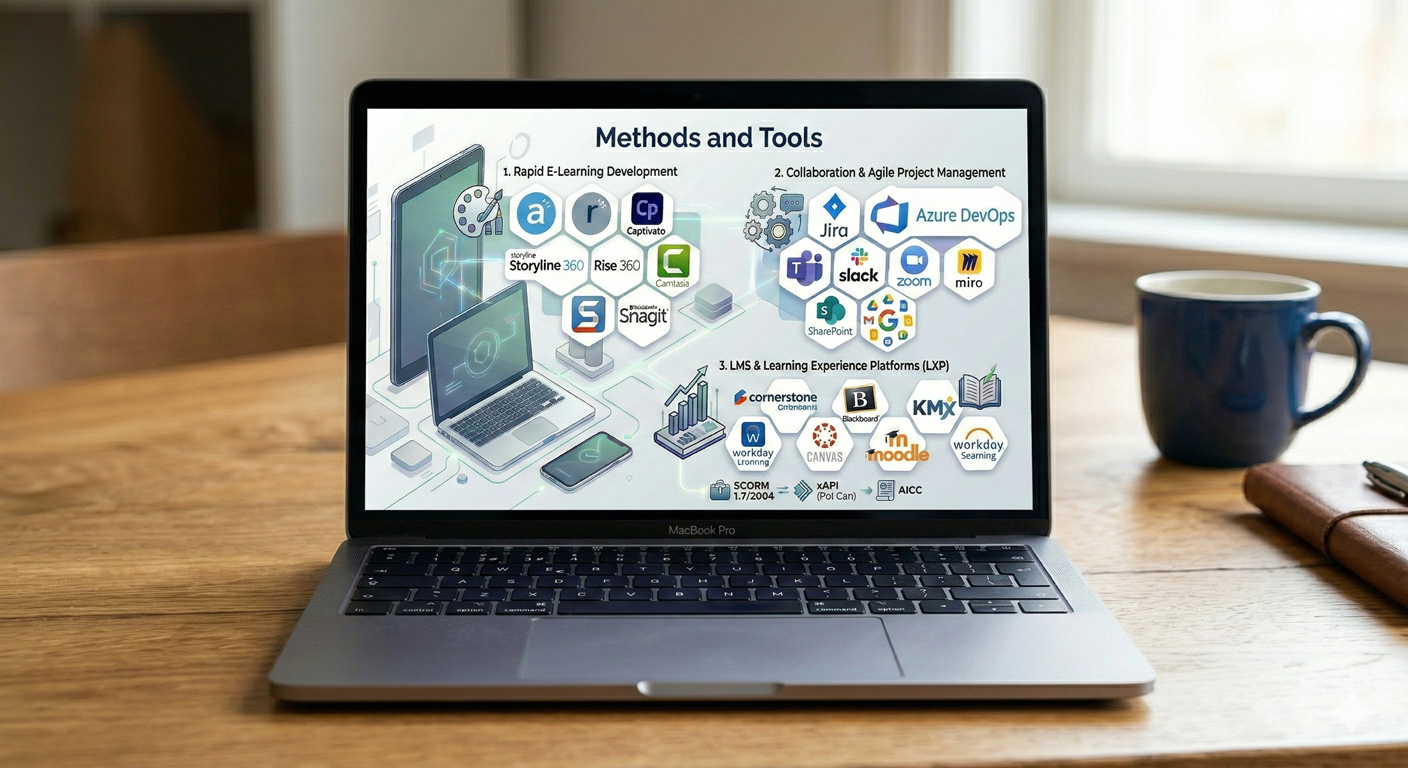
While I am tool-agnostic and adapt to the client’s infrastructure, I have a “core stack” I rely on for rapid development and high-efficiency workflows. If your organization uses these platforms, we can hit the ground running immediately.
- Primary Authoring: Articulate Storyline 360 (for high-level interactivity) and Rise 360 (for fast, responsive mobile learning).
- Rapid Prototyping: Snagit and Camtasia for quick screen captures, video walkthroughs, and feedback cycles.
- Agile/Project Tracking: Jira and Azure DevOps are my go-to environments for managing development sprints and maintaining transparent version control.
- LMS Integration: I have experience with several LMSs such as Cornerstone OnDemand, Blackboard and KMx. No matter the LMS my job is to ensure that the content I build isn’t just visually engaging, but technically sound upon deployment.